

Bitcoin climbed past $85,000 as a wave of short liquidations fueled the cryptocurrency’s most powerful advance since January.
Figures from CryptoSlate revealed that BTC rose over 5% in a 24-hour window to hit $85,193, pushing its 35-day gains to roughly 29%. Following the breach of levels that had previously capped its recovery throughout much of the year, the asset retreated slightly to trade at $84,545 by press time.
The upward surge left bearish market participants heavily exposed. According to CoinGlass statistics, approximately $750.5 million in leveraged crypto positions were wiped out over the prior 24 hours, with short positions accounting for more than $648 million, or about 86%. In total, 137,386 traders faced liquidations during this timeframe.
Bitcoin made up roughly $360 million of these liquidations, while Ethereum contributed nearly $171 million. The largest single wipeout involved an 11.29 million BTC-USDT position on Binance.
This forced unwinding occurred alongside a dramatic surge in aggressive buying across Bitcoin derivatives platforms. Data from CryptoQuant indicated that net taker volume on Binance spiked from approximately $11 million to $618 million within the span of an hour during the opening of European trading, pointing to an abrupt surge in market buyers.
CryptoQuant linked the shift partly to an amelioration in geopolitical sentiment, sparked by investor reactions to potential diplomatic headway between the United States and Iran. Amid market evaluations of possible talks, oil prices also dropped, aiding a wider recovery in risk appetite despite ongoing regional conflicts.
Simultaneously, high leverage amplified price action for BTC. Bitcoin open interest sits near $28.83 billion, matching levels close to its May record, which leaves a vast pool of derivatives contracts susceptible to additional volatility.
While such market positioning can continue to benefit Bitcoin if prices climb and compel further short sellers to cover, it equally exposes the market to sharper pullbacks.
Conversely, should Bitcoin lose steam, leveraged long positions might unwind swiftly, transforming the exact mechanisms that propelled the rally into heavy selling pressure.
Bitcoin clears long-term bear-market markers
The push above $85,000 also carried Bitcoin past technical benchmarks that traders have monitored for months as signs that the market downturn is concluding.
Last week, Bitcoin closed above its 50-week moving average for the initial time since November 2025, wrapping up a 45-week period beneath that line. Alex Thorn, head of firmwide research at Galaxy Digital, noted that past recoveries of this metric have frequently signaled reliable confirmation that a bear-market low had already been set.
This indicator is not infallible; Galaxy research points out that Bitcoin has previously recaptured the 50-week average only to sink back below it, such as during the 2021-2022 bear market.
Ki Young Ju, chief executive of CryptoQuant, pointed to another closely watched threshold as Bitcoin reclaimed its 365-day moving average near $83,000. He suggested that maintaining this level might draw back momentum traders and institutional investors who stayed sidelined throughout the downturn.
Consequently, Bitcoin analyst Joe Consorti asserted that the market is tentatively stepping into a “bull market.”
Even so, the robust breakout has not yet triggered a matching rise in underlying blockchain activity.
Analytics firm Santiment reported that new and active Bitcoin addresses stayed close to their median levels recorded between July 24 and September 20, even as prices broke upward. Although social activity ticked up to 1.23 times its baseline and transactions exceeding $100,000 reached 1.18 times normal levels, neither metric hit a two-month high.
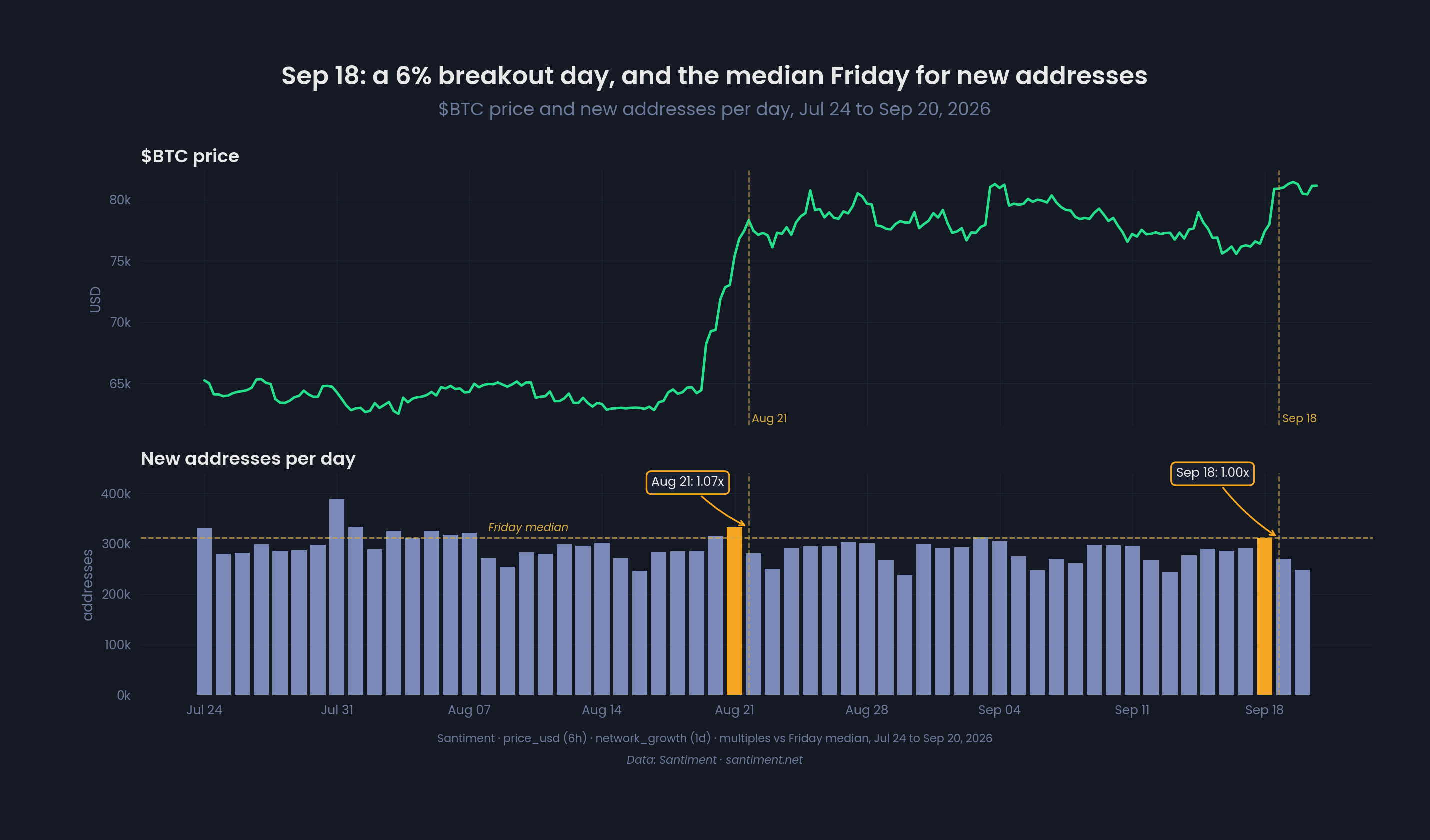
This divergence stood out when compared to Bitcoin’s August 21 rally, when the asset jumped nearly 7%. That movement spurred greater wallet involvement despite resulting in a less significant technical breakout, with new addresses hitting 1.07 times their baseline and active addresses rising to 1.14 times.
Santiment noted that over the past two months, 10 individual weekdays generated a higher count of new wallets than the September 18 breakout session.
By contrast, derivatives activity proved much more vigorous. Open interest spiked roughly 9% on September 18 and has stayed elevated, highlighting a growing disconnect between leveraged market participation and actual engagement on the Bitcoin network.
Because of this divergence, the longevity of the rally relies increasingly on the appearance of fresh spot demand. While forced buying from short liquidations can drive Bitcoin past resistance levels, its effect wanes once bearish bets are cleared out. Sustaining a price above $85,000 will demand new capital to supplant traders who were compelled to buy back their losing positions.
